A District Before It's Finished
Living and working in a place that is still taking shape
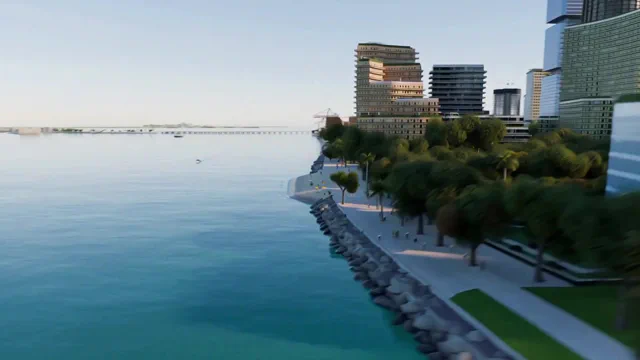
A coastal district should be worth spending time in while parts of it are still being built. The finished waterfront has to make sense alongside the work that brings the rest of the place into use.
A short concept film explores this through an imagined district. It opens on a busy street, close to the people walking between buildings. The camera moves toward the water and through a greener urban area, then pulls back across working yards and unfinished land. By the time the whole district comes into view, several stages of construction are visible together.
This is an AI-generated concept film.
Base data: © OpenStreetMap contributors (ODbL); Miami-Dade County GIS Technical Support Group (for illustration purposes only); NOAA NCEI (CUDEM 1/9 arc-second; CUDEM 1/3 arc-second); NOAA Office of Coast Survey; © ESA WorldCover project 2021 / Contains modified Copernicus Sentinel data (2021) processed by ESA WorldCover consortium (CC BY 4.0). Data adapted for this concept visualization; not for navigation.
Chart-derived illustration: NOAA Office of Coast Survey. Modified for visualization; not for navigation. NOAA ENC terms.
I wanted the new district to have more greenery and room to walk. I also wanted industry to have a place in it, and the process of construction to stay visible. Those choices belong together. A place intended for everyday life should account for the work happening there, including the work of building it.
Whether a district like this could be built and work as intended remains open.
Starting at street level gives the rest of the film a point of reference. There are people on the sidewalks and buildings close enough to feel their scale. That perspective remains useful when the camera moves into the new district. A person still has to find a way through the space underneath the skyline.
The design direction includes tall buildings alongside lower civic or educational buildings, with greenery and room to walk. Density remains part of the idea. The question is what happens between the buildings and at their entrances. Where could someone stop without being in the way? What would make a walk through the district pleasant enough to take when there isn’t a camera there?
The film gives a sense of the waterfront and the trees, but the new district reads quieter than the opening street. It leaves much of the everyday activity to the viewer’s imagination.
The starting city has life in it already. The ambition for the new district is to give that life more room. It would be a strange improvement if the buildings became more beautiful while the people became incidental.
The working waterfront stays in the picture as the camera pulls back. The yards and port are part of the district’s intended life. Keeping them visible puts a demand on the idea of a human-friendly place. That idea has to include someone arriving to do physical work as well as someone arriving for a walk.
What work would happen in those yards, and how would people reach it? Where would materials arrive, and how would they get to the place they’re needed? Giving the work a location makes it possible to ask those questions about a particular arrangement of space.
The working area should remain visible when the image becomes polished. It’s part of the purpose of the district and belongs in any judgment of it. A waterfront walk and a working yard each need room for their own activity. Their relationship would need to be worked out in enough detail that neither exists only to make the overall picture more appealing.
The construction stages extend that question through time. The concept places a finished urban area beside buildings under construction, then ground at earlier stages of preparation, out to the formation of new land. Several moments in an imagined district’s life become visible in one view.
Showing them together makes the finished part harder to consider in isolation. Imagine someone using the waterfront while another part of the district is still a work site. Their route through it has to exist at that moment. A connection drawn through a future building site wouldn’t help them. The plan would have to explain what they could use now and what would remain unavailable.
The same question applies to the working area. If it is meant to operate while the district grows, its access can’t depend on the whole picture being finished. A review of an intermediate stage would need to follow the people and materials through that stage. It would need to identify which parts could function together and which depend on something still missing.
I think each stage deserves to be considered as a place someone might encounter. A first occupied area would need a coherent life of its own, even with more building ahead. Later work would have to account for the people already there.
An unresolved connection in one of those stages could be worth investigating before the design goes further. In Build Evidence Before You Build Commitment, I argue for buying only the information needed to justify the next expensive or hard-to-reverse decision. Here, that would mean identifying a particular assumption about how a stage could function and deciding what evidence would be needed to support it.
I’m interested in what a day could look like along the way, with the waterfront in use and the next piece still being made. The design should be able to explain that day.