The Permit Is Part of the Design
A coastal project is shaped by alternatives, jurisdiction, navigation, species protection, public trust, mitigation, and the separate work of securing construction funds.
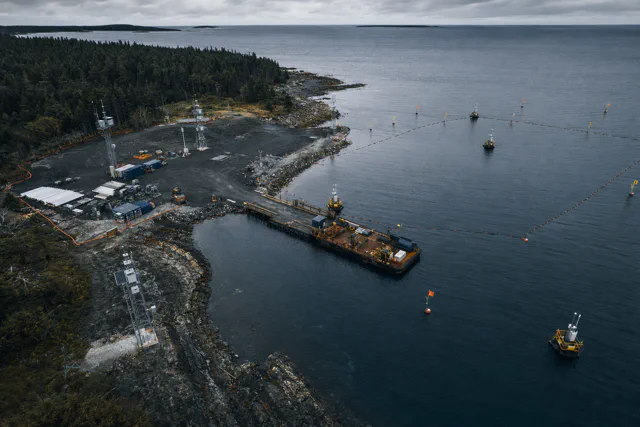
Coastal proposals often harden around a drawing before their controlling questions have been answered. Once an offshore line carries a fill quantity, it begins to look settled, and permitting gets pushed into a later phase.
In practice, the drawing is one candidate among several. A permit-ready design must establish what will be built, why it must occupy water, which waters and lands it will affect, who controls them, how navigation will continue, what material will move, which species and habitats are present, and what follows if performance departs from the model. Each answer can move an opening, change a material source, alter staging, shrink the footprint, or displace the project entirely.
Permitting helps make the design. It tests the candidate against alternatives, jurisdiction, navigation, ownership, species, habitat, performance, and long-term responsibility while the geometry can still change.
Define the action
The first useful document is a precise description of the proposed action. It identifies the applicant, project purpose, construction and operating activities, material sources, receiving area, sequence of work, expected maintenance, and the public and private decisions required to proceed. It also separates necessary functions from preferred features. A navigation facility presents a different alternatives problem from housing or commercial development, even when both use the same fill footprint.
The same discipline applies to jurisdiction. A coastal map does not answer whether every feature is within federal Clean Water Act jurisdiction, whether it lies in navigable waters regulated under the Rivers and Harbors Act, or whether the seabed is owned by Florida, the federal government, or another party. Those questions require current surveys, jurisdictional analysis, title work, and agency coordination. They should be resolved before the project depends on a particular boundary.
A federal permit creates a federal connection, but it does not automatically convert every component of a private development into a federal project. The responsible agency defines the action it is reviewing under the statute and its own procedures. The practical consequence is that applicants need a clear project description and a defensible account of which consequences follow from the federal decision. Ambiguity here expands disputes later.
Land control is separate. A dredge-and-fill permit does not convey title, a lease, an easement, or permission from the owner of the submerged land. A project can satisfy an environmental standard and still lack the property authority needed to build.
Alternatives change the footprint
Section 404 of the Clean Water Act governs discharges of dredged or fill material into waters of the United States. The U.S. Army Corps of Engineers administers the permit program for most projects, using the Environmental Protection Agency’s Section 404(b)(1) Guidelines. The Guidelines put practicable avoidance before compensation: a discharge may not be permitted if a practicable alternative would have less adverse effect on the aquatic ecosystem without creating other significant environmental consequences.
For an activity that does not require access or proximity to water, the guidelines presume that practicable upland alternatives are available and that those alternatives are less damaging, unless the applicant clearly demonstrates otherwise. That presumption matters for land creation intended to support uses that could occur inland. The applicant cannot avoid it by defining the project purpose so narrowly that only the preferred offshore site appears to work.
An honest alternatives analysis can test:
- whether the need can be met on existing land;
- whether a smaller footprint performs the necessary function;
- whether detached features work better than a continuous fill body;
- whether an existing disturbed area can be used instead of intact habitat;
- whether dredged material can be placed in a different form or location;
- whether construction can be phased so later segments depend on measured performance;
- and whether the no-action condition is preferable once maintenance and induced effects are counted.
The Corps’ public-interest review adds a broader balance. It considers conservation, economics, flood hazards, navigation, shoreline erosion, water quality, property ownership, the needs and welfare of the public, and other relevant factors. A design that survives the aquatic alternatives test can still change when weighed against navigation, flood behavior, public access, or long-term maintenance.
This is why purpose is a design input. A real public need may justify a water-dependent solution. A preference for newly created waterfront does not establish one.
Navigation is a physical constraint
Section 10 of the Rivers and Harbors Act prohibits unauthorized obstructions and alterations in navigable waters of the United States. Its operative language covers structures, excavation, fill, and other work that can affect navigable capacity. The current statute is codified at 33 U.S.C. §403.
Navigation review reaches beyond the marked federal channel. A project can alter approach paths, turning areas, anchorages, tidal currents, shoaling patterns, recreational routes, emergency access, and the room available for future channel maintenance. Construction adds temporary conflicts from pipelines, barges, turbidity controls, exclusion areas, and nighttime operations.
These are geometric questions. A continuous causeway may become a bridged opening. A narrow opening may become a wider span after current and vessel analysis. A fill edge may move away from a channel or inlet. Staging may shift to a different season or route. A project near a maintained inlet may need to preserve the tidal prism and sediment pathways that keep the inlet stable. The relevant analysis belongs in the design model, not in a navigation appendix written after the footprint has been fixed.
The result may also include operating obligations. Marking, inspection, maintenance dredging, storm debris removal, and access for federal or local navigation work can persist for the life of the project. A design is incomplete if no institution is responsible for those duties.
NEPA still governs the federal decision
Effective January 8, 2026, the Council on Environmental Quality removed its government-wide NEPA implementing regulations. The final rule removed that common regulatory layer; the National Environmental Policy Act itself remains in force.
Federal agencies now apply the statute through their own procedures. For the Corps, current procedures include 33 CFR part 333. The level of review follows the proposed federal action and its expected effects. An agency may use an applicable categorical exclusion, prepare an environmental assessment, or prepare an environmental impact statement when statutory and agency standards call for one.
Whatever the level, the analysis must support the federal decision by describing reasonable alternatives, affected resources, environmental consequences, and measures that avoid or reduce harm. Its information must fit the maturity of the decision. A conceptual rendering cannot support detailed impact conclusions, while a fully committed design can empty alternatives review of practical meaning.
Starting while alternatives remain open allows hydrodynamic models to compare footprints, habitat surveys to redirect placement, and construction methods to account for noise, turbidity, vessel traffic, and seasonal constraints. The resulting environmental review records a decision already improved by engineering.
The NEPA document’s statutory schedule leaves two other sets of dependencies intact. Section 404, Section 10, endangered species consultation, state certification, coastal consistency, and submerged-land authorization each require their own legal findings; design, contracting, and appropriations follow separate delivery decisions. Coordination can reuse evidence and reduce duplicate work while preserving every required finding and funding decision.
Species consultation changes means and timing
Section 7 of the Endangered Species Act requires each federal agency, in consultation with the U.S. Fish and Wildlife Service or NOAA Fisheries, to ensure that its action is not likely to jeopardize a listed species or destroy or adversely modify designated critical habitat. Consultation is attached to the federal action, not added at the end by the applicant.
Many projects conclude through informal consultation when the action agency and the relevant wildlife agency determine that the action is not likely to adversely affect listed species or critical habitat. Formal consultation begins when adverse effects are likely and the required information is sufficient to initiate it.
The timing is often misstated. Under 50 CFR §402.14, formal consultation is ordinarily concluded within 90 days, followed by 45 days for delivery of the biological opinion. The agencies may agree to extend consultation. When an applicant is involved, an extension longer than 60 days requires the applicant’s consent. Those periods begin with formal initiation, not with the first project meeting, and they do not include the time required to collect missing surveys, revise an incomplete biological assessment, or redesign an action that cannot satisfy the statute.
Consultation can alter fill location and the means and timing of construction: dredging equipment, vessel speeds, lighting, noise controls, observer requirements, exclusion zones, work windows, and monitoring. A jeopardy or adverse-modification conclusion may require broader change through reasonable and prudent alternatives. An incidental take statement authorizes take associated with an otherwise compliant federal action only under its terms.
The 2020 South Atlantic Regional Biological Opinion, SARBO, provides a regional biological opinion for specified Corps and Bureau of Ocean Energy Management activities within its scope. It can make covered, recurring work more consistent; it supplies neither a programmatic environmental impact statement nor a blanket authorization for novel reclamation.
State review remains independent
A federal permit involving a discharge can require state water-quality certification under Section 401 of the Clean Water Act. The state evaluates whether the discharge will comply with applicable water-quality requirements and may certify, condition, deny, or waive within the federal framework. EPA’s Section 401 overview explains the current process. Conditions that survive certification become conditions of the federal license or permit.
In Florida, applicants should not assume that the state is presently issuing Section 404 permits in place of the Corps. The Florida Department of Environmental Protection states that its State 404 Program is inoperative and that it lacks authority to issue State 404 permits following the program’s vacatur. The U.S. Court of Appeals for the District of Columbia Circuit affirmed that vacatur on March 27, 2026. As of July 19, 2026, a Florida coastal proposal should plan for the applicable federal Section 404 route while separately completing state reviews.
Those state reviews may include an Environmental Resource Permit, requirements in FDEP’s beaches and coastal systems rules and statutes, including the Joint Coastal Permit for qualifying coastal activities, and review under the Coastal Construction Control Line program. The exact combination depends on the location and activity. The design must also account for local comprehensive planning, utilities, stormwater, access, and building approvals. No single coastal permit replaces the rest.
The Coastal Zone Management Act adds another distinction. A federal agency activity follows the federal-agency consistency process. An applicant seeking a listed federal license or permit follows the federal-license-or-permit consistency process. NOAA’s federal consistency overview and 15 CFR part 930 set out those separate routes. Florida implements them through the Florida Coastal Management Program. Calling both routes “CZMA review” hides who must submit what and which standard applies.
Submerged land carries public-trust obligations
Florida’s Constitution makes submerged-land authority a threshold issue. Article X, section 11 provides that lands under navigable waters, including beaches below the mean high-water line, are held by the state in trust for all the people. Sales or private uses may be authorized only when they are not contrary to the public interest. The controlling text is in the Florida Constitution.
The Board of Trustees of the Internal Improvement Trust Fund administers Florida’s sovereignty submerged lands through leases, easements, consents of use, and other instruments. FDEP describes the current submerged-lands management process.
This authority cannot be treated as a clerical title transfer. The public-trust inquiry reaches navigation, fishing, bathing, access, habitat, and other public uses. A proposal that converts open water into exclusive development has to confront that change directly. A special district may eventually finance infrastructure or operate services, but ordinary legislation cannot erase the constitutional trust or substitute local approval for action by the state trustees. Governance follows lawful land authority. It does not create it.
The same point applies offshore. Federal mineral leasing, state submerged-land consent, a Corps permit, and local land-use approval answer different questions. Holding one does not imply the others.
Mitigation is an operating commitment
Federal mitigation follows a sequence: avoid impacts where practicable, minimize those that remain, then compensate for unavoidable losses. The Corps’ 2008 Mitigation Rule requires more than a promise to restore habitat somewhere later. A compensatory mitigation plan can include objectives, site protection, baseline information, a work plan, maintenance, ecological performance standards, monitoring, long-term management, adaptive measures, and financial assurances.
Those terms should influence design before permit issuance. If a habitat feature cannot be monitored, its claimed benefit is weak. If a public entity will inherit maintenance, that entity must understand the obligation and have a funding source. If compensation depends on a separate site, control of that site and the schedule for its work matter. If a feature needs perpetual nourishment or invasive-species control, the lifecycle cost belongs in the project economics.
Mitigation also has limits. Compensation does not make an avoidable discharge permissible. A permit condition cannot turn an unstable inlet, an unsafe navigation opening, or an unfinanceable maintenance plan into a sound project. It can only define and enforce the performance expected from an otherwise lawful design.
Permission and delivery follow separate paths
There are two broad federal pathways, and they should not be conflated.
A private or nonfederal sponsor can design a project, secure property interests, apply for federal and state permits, obtain local approvals, and finance construction. The Corps acts as regulator for the relevant permits. Approval allows specified work under specified conditions. It does not promise federal construction money, assume the applicant’s maintenance duties, or guarantee that another agency will fund connected infrastructure.
A Corps Civil Works project follows a public planning and authorization process. Depending on the authority used, it can require a feasibility study, environmental compliance, a nonfederal sponsor, cost-sharing commitments, congressional authorization, design, and appropriations. Authorization establishes legal authority for the project or program. Appropriation provides budget authority to spend. An authorized project can remain unbuilt if Congress does not appropriate construction funds or if required sponsor commitments are absent.
That distinction changes early strategy. A proposal should not depend on a future federal adoption that no agency or Congress has agreed to. Nor should an authorization be presented as if construction were funded. The delivery plan must identify, decision by decision, who has authority, who pays, who owns the result, and who operates it after the ribbon cutting.
By the time the permit record is complete, the preferred project may have a smaller footprint, different openings, another material source, seasonal work restrictions, habitat features, monitoring thresholds, financial assurances, and an owner or operator unlike the one assumed in the first sketch. Those changes mark the transition from an image to a design capable of lawful performance.
The resulting footprint remains conditional on continuing duties: preserve navigation, comply with permit and consultation terms, maintain mitigation, monitor performance, fund repair, and respond when the project falls outside its expected range. Delivery therefore depends on durable land authority, an accountable owner, and revenue that lasts beyond construction. Without all three, the project cannot be built and kept in compliance.