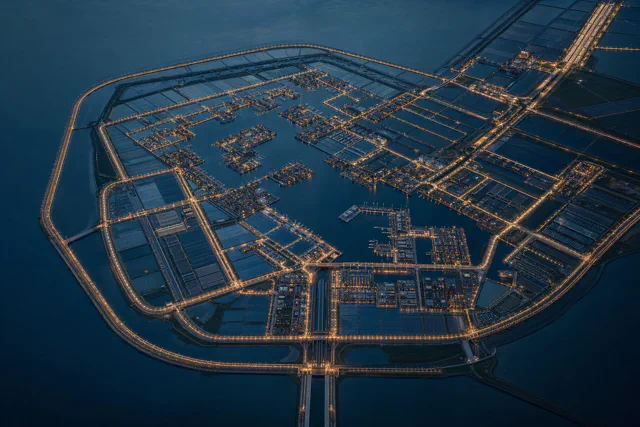
New land is expensive to build and cheap to regret. The engineering cost of large-scale reclamation runs from roughly €1.5 million to €3 million per usable hectare at project scale, depending on water depth, seawall design, and ground improvement requirements. The land produced sells or leases at multiples of that cost in nearly every demonstrated case. The gap between construction cost and land value is where territorial engineering becomes economically interesting, and where the design of financing and ownership structures determines whether the surplus goes to the public, to developers, or to debt service.
This document covers the $/ha benchmarks from five major projects, the financial performance of port authorities that own reclaimed territory, the mechanisms through which value is captured, the bond structures that have financed construction, and the real-estate economics of engineered versus legacy waterfront. It draws on cases in the Netherlands, Singapore, Denmark, the UAE, and the United States. The cautionary material is here alongside the successful cases. Palm Jumeirah required a $9.5 billion sovereign bailout. The 2008 Florida community development district default wave wiped out $5.1 billion in face-value municipal bonds. The structure matters as much as the underlying land.
Construction cost benchmarks
Published per-hectare cost figures for reclamation projects vary because projects report total investment in different ways: some include only civil construction, others include terminal superstructure, and some include financing costs over the construction period. The table below uses the most consistently defined figure available for each project, which is total civil-works cost divided by usable area produced.
| Project | Usable area | Total civil cost | Cost per usable ha | Primary source |
|---|---|---|---|---|
| Maasvlakte 2, Rotterdam | ~1,000 ha | ~€2.9 billion | ~€2.9 million/ha | Port of Rotterdam; EIB [Port of Rotterdam, 2024 Annual Report] |
| Lynetteholm, Copenhagen | 275 ha (full buildout) | ~DKK 3 billion Phase 1; ~$3.2B total | ~$11.6 million/ha | By & Havn; Time, 2023 |
| Battery Park City, New York | 37 ha (92 acres) | Fill from WTC excavation; no separate fill cost | Not applicable (zero-cost fill) | BPCA |
| Palm Jumeirah, Dubai | Residential island | $12 billion total | Not published per ha | Apil Properties, 2024 |
| Jurong Island, Singapore | 3,200 ha | S$7 billion (Phases 1-3) | ~S$2.2 million/ha | JTC; PEMP |
These figures are not directly comparable. Maasvlakte 2 is deep-water industrial port land requiring 20-meter port basins and 3.5 km of hard seawall. Battery Park City used free excavation spoil and faces tidal Hudson River, not open ocean. Lynetteholm’s high per-hectare figure reflects that its fill is construction soil delivered by road and barge from other Copenhagen building sites, with soil receipt fees partly offsetting the cost rather than adding to it. Palm Jumeirah’s $12 billion total includes Nakheel’s construction, the palm trunk, and supporting infrastructure but is divided across a complex planform with a large non-residential footprint.
The Maasvlakte 2 figure is the most directly useful benchmark for open-coast industrial reclamation. At €2.9 million per usable hectare, a 1,000-hectare project costs roughly €2.9 billion. The EIB provided €900 million of that at 30-year maturity; the Port of Rotterdam Authority funded the balance through equity and operating cash flow. APM Terminals then invested approximately €500 million of its own capital to build the terminal superstructure on the leased land. The public entity bore the land creation cost; the tenant bore the operational investment cost. That is the standard landlord-model division of risk in developed-country port finance.
Lynetteholm is the outlier in per-hectare cost because it is designed as residential and urban land, not industrial port land, and because Copenhagen’s labor and materials costs differ from Rotterdam’s. It is also the project still under construction, with Phase 1 coming in at DKK 497 million against a DKK 300 million budget, a 67% overrun attributed primarily to steel price spikes in 2022. Per-hectare cost for a completed project will not be known until the 2070 full buildout.
Port authority financial performance
The strongest economic cases for reclamation are port projects operated by public authorities under the landlord model: the authority owns the land, leases it to terminal operators and industrial tenants, and collects both throughput-based fees and ground rent. The three major demonstrated cases are Rotterdam, Singapore Jurong/Tuas, and Battery Park City.
Rotterdam HbR. Havenbedrijf Rotterdam N.V. (HbR) is owned 70.83% by the City of Rotterdam and 29.17% by the Dutch state, corporatized from a municipal department in 2004. It holds all port land under a concession in perpetuum from the city. Maasvlakte 2 added roughly 1,000 ha of leasable industrial land to the port’s territory.
| Year | EBITDA (EUR M) | Net profit (EUR M) | Containers (M TEU) |
|---|---|---|---|
| 2022 | not reported | 247.2 | 14.5 |
| 2023 | 548.6 | 233.5 | 13.4 |
| 2024 | 563.5 | 273.7 | 13.8 |
The EIB €900 million loan is being serviced from these operating revenues. Gross capital investment in 2024 was €320.6 million, supporting quay wall expansion at Prinses Amaliahaven, Porthos CO2 transport infrastructure, and Yangtzekanaal widening. The authority holds investment-grade ratings from Moody’s and S&P. No direct per-TEU profitability figure is publicly disclosed at terminal level; combined seaport dues and rental/leasehold income generated H1 2024 revenues of €439.6 million. [Port of Rotterdam Authority, 2024 Annual Report]
The APM Terminals expansion announced in March 2023 will add 47.5 ha and 1,000 meters of quay to Maasvlakte 2 for over €1 billion of terminal capital investment. The authority provides the land; the tenant finances the equipment. Each hectare of leasable industrial port land thus attracts €20-25 million in tenant capital at current APM Terminals build-out density, on top of the €2.9 million per hectare that built the land.
Singapore JTC/PSA. Jurong Island assembled seven offshore islets into a single 3,200-hectare petrochemical hub through reclamation from 1995 to 2009. JTC Corporation, a statutory board under Singapore’s Ministry of Trade and Industry, owns the land and grants 20- to 60-year industrial leases. Total tenant investment in Jurong Island exceeded S$30 billion by 2009; the island processes more than 1.5 million barrels of oil per day and functions as one of the three largest refining centers globally. Phases 1-3 cost S$7 billion to build; the tenant investment that followed was more than four times the construction cost. [JTC Corporation; PEMP]
Tuas Mega Port extends this model to container handling. Phase 1 opened September 2022 on 294 ha of reclaimed land at S$2.42 billion; four phases will ultimately produce 1,337 ha, 66 berths, and a design capacity of 65 million TEU. PSA Singapore handled 40.9 million TEU in 2024, a record. The operator is PSA International, majority owned by Temasek Holdings, Singapore’s sovereign wealth fund. Revenue runs approximately S$8 billion annually at the group level. [PSA International, 2024 Annual Report]
Battery Park City. The 92-acre (37-hectare) landfill on the lower Hudson River is the US reference case for ground-lease value capture. The Battery Park City Authority (BPCA), created by the New York State Legislature in 1968, owns all land permanently and leases parcels to private developers who own their buildings. Revenue flows through two primary instruments.
PILOT: payments in lieu of taxes, which substitute for conventional property tax and flow through BPCA to New York City. PILOT totaled approximately $298 million in the most recently reported fiscal year, roughly 78% of total revenues. [BPCA Investor Relations, BondLink]
Ground rent: annual lease payments from lessees to BPCA for land use. Ground rent totaled approximately $57.3 million, roughly 15% of total revenues.
Total annual revenues: approximately $382 million on 37 hectares of reclaimed land.
Since inception BPCA has transferred more than $1.4 billion net to New York City, including a $600 million single transfer in 1989. Annual contributions to the city have run approximately $200 million in recent years. BPCA has contributed more than $460 million to citywide affordable housing since 2010 and announced a $500 million disbursement to the city’s Affordable Housing Accelerator Fund in 2024. Senior bonds carry AAA ratings from Fitch and Moody’s on approximately $1.07 billion in outstanding debt. The authority has no taxing power. Its sole security is the ground lease revenue stream. [BPCA; Fitch, Nov 2025]
The Battery Park City yield on reclaimed land is roughly $10.3 million per hectare annually, before deducting operating expenses and debt service. That figure depends entirely on lower Manhattan real estate values, which are among the highest in the world. It does not transfer to other locations. What transfers is the institutional structure: public authority, permanent land ownership, ground lease to private developers, PILOT to host city, revenue bonds backed by the lease stream.
Value capture mechanisms
Six mechanisms have been used to recoup reclamation capital costs and generate ongoing fiscal return. They are not mutually exclusive; successful projects typically combine several.
| Mechanism | Definition | Demonstrated case | Risk |
|---|---|---|---|
| Ground-lease recoupment | Public entity owns land, leases to private users, collects rent over decades | Battery Park City (PILOT $298M + rent $57.3M/yr); Rotterdam (concession in perpetuum); Jurong (JTC 20-60yr leases) | Rent resets at market; commercial office exposure (BPC risk factor cited by Fitch) |
| Port throughput revenue | Per-vessel and per-TEU fees on cargo moving across reclaimed quays | Rotterdam (seaport dues + leasehold = €440M H1 2024); Georgia Ports 5.7M TEU FY2024 | Volume concentration; shipping market cycles |
| Infrastructure bond (revenue) | Bonds backed by pledge of project revenues, not government taxing authority | BPCA senior bonds (AAA, $1.07B); GPA revenue bonds ($425M Oct 2021); PANYNJ consolidated bonds | Revenue decline; debt service coverage ratio |
| TIF (Tax Increment Financing) | Future property tax increment above baseline pledged to retire infrastructure bonds | Used in US waterfront districts; not applicable in European port cases | Requires established property tax base; increment may underperform projections |
| Development bank loan | Long-tenor concessional debt from EIB or similar, secured against government equity and project revenues | EIB €900M, 30-year, for Maasvlakte 2 | Requires public ownership or sovereign guarantee; not available to purely private projects |
| P3 / private operator contribution | Private terminal operator or industrial tenant contributes capital toward public infrastructure in exchange for lease or throughput rights | JAXPORT: SSA Atlantic contributed private capital to $420M deepening, first such instance in US port history [JAXPORT, 2022] | Operator may exit; requires long-term commercial commitment |
| Sovereign wealth co-investment | State-owned enterprise or SWF provides equity backstop, enabling commercial debt at lower spread | PSA/Temasek for Tuas; Dubai World/Nakheel for Palm Jumeirah | Sovereign balance sheet exposure; governance risk when projects underperform |
Special assessment districts (SADs) and community development districts (CDDs) under Florida Chapter 190 are a distinct mechanism applicable to residential and resort reclamation. CDDs levy non-ad-valorem assessments on property within the district to retire infrastructure bonds. Approximately 1,067 CDDs were active in Florida as of August 2025. The mechanism works when absorption projections are accurate; the 2008 default wave, in which 168 CDDs defaulted on approximately $5.1 billion face-value municipal bonds, resulted from speculative projections that collapsed in the housing correction. For coastal reclamation districts, CDD debt coverage depends on lot-sale or assessment revenue that must be sized against realized rather than projected absorption. [Florida special-districts.md]
Lynetteholm uses a variant: By & Havn charges construction contractors disposal fees for depositing surplus excavated soil on the reclamation site, projected at DKK 2 to 2.5 billion PV, roughly matching the Phase 1 perimeter construction cost. Construction waste disposal revenue converts a cost center for other Copenhagen projects into a revenue stream for the reclamation. This is transfer pricing within a construction market, not a land-value mechanism, but it substantially reduces net project cost.
Bond structures and financing
The financing structures used across the five main cases reflect both the ownership model and the host jurisdiction’s capital markets.
EIB 30-year loan (Maasvlakte 2). The European Investment Bank provided €900 million in tranches from 2008 through 2012, at 30-year maturity, secured against HbR’s operating revenues and the Dutch state’s 29.17% equity stake. HbR’s CFO Paul Smits explicitly cited the EIB terms as chosen for “long loan maturities, contracting flexibility, and favourable terms particularly well adapted to large-scale infrastructure.” The 30-year tenor eliminates refinancing risk through the period of revenue ramp-up, which for port infrastructure is measured in decades. No commercially available long-term debt achieves equivalent terms without a sovereign backstop. [EIB press releases, 2008, 2012]
Revenue bonds (Battery Park City, Georgia Ports). BPCA’s senior bonds are rated AAA by both Fitch and Moody’s, backed solely by ground lease revenues, with no general-obligation guarantee from New York State. The additional bonds test requires pledged revenues to cover pro forma maximum annual debt service at 2x for senior lien and 1.55x combined senior and junior. Outstanding debt of approximately $1.07 billion is serviced from a revenue stream averaging $382 million annually. The 2025 capital budget of approximately $400 million is directed primarily to storm surge barriers and elevated infrastructure on the waterfront, financed by a new AAA-rated $662 million Series 2025 issuance. [Fitch, Nov 2025]
Georgia Ports Authority issued $425 million in revenue bonds in October 2021, backstopped by port operating revenues from the Port of Savannah, which handled 5.7 million TEU in FY2024, roughly 10% of all US containerized cargo. GPA’s 10-year capital plan targets $4.5 billion for five new big-ship berths at Savannah and a fourth berth at Brunswick. GPA holds the highest bond rating of any Southeast US port. [GPA Investor Relations]
GO bonds (Port Houston). Port Houston Authority of Harris County has taxing authority over Harris County real property and issues general obligation bonds backed by the ad valorem tax base, in addition to revenue bonds backed by port operating revenues. The dual structure allows the authority to use the lower-cost GO credit for lumpy, slow-return infrastructure (channel dredging, cranes) while reserving revenue bonds for project-specific capacity with identifiable revenue streams. Fitch rates Port Houston’s unlimited tax bonds at AA. [Fitch, 2023]
Off-plan presales (Palm Jumeirah). Nakheel financed Palm Jumeirah construction primarily through off-plan residential presales, requiring 30-50% deposits from buyers before construction of their units. During the 2004-2008 market, Palm Jebel Ali presales traded at 200% premiums in secondary markets. This structure is viable only with either a deep institutional takeout market or sovereign backstop. Nakheel had neither when the 2008 financial crisis collapsed the Dubai residential market. Dubai World requested a debt standstill in November 2009. Abu Dhabi injected $10 billion into Dubai in December 2009. The Government of Dubai provided $9.5 billion specifically to ensure Nakheel bondholders were paid in full. The 2011 AED 59 billion debt restructuring completed the resolution. Nakheel merged into Dubai Holding in March 2024. [Nakheel Properties, Wikipedia; Apil Properties, 2024]
The Palm Jumeirah villas have since recovered and exceeded pre-crisis values. In Q1 2025, villas traded at AED 15.95 million to AED 200 million, up 41% year over year and 63% above 2014 peaks. The highest single villa sold for AED 230 million in January 2025. Frontage does compound over long horizons. Debt that cannot survive the cycle to reach those horizons produces sovereign bailouts, not returns.
P3 / private contribution (JAXPORT). The JAXPORT Harbor Deepening Project deepened 11 miles of channel from 40 feet to 47 feet, at a total cost of $420 million, completed May 2022, seven months ahead of schedule. Funding came from the US Army Corps of Engineers (approximately 50%), the City of Jacksonville ($70 million grant plus $40 million bridge loan), the State of Florida, JAXPORT itself, and SSA Atlantic, the private terminal operator at Blount Island. SSA Atlantic’s participation was the first private-business contribution to a US port deepening project. [JAXPORT, 2022; Jax Daily Record, 2022]
This structure extends the capital base available for port infrastructure beyond federal appropriations, which have been the binding constraint on US port deepening historically. The economic case: JAXPORT projected $24 in statewide return per $1 invested, with 15,000 jobs created or protected. At 47-foot depth, JAXPORT became the first US East Coast port of call for fully loaded post-Panamax vessels.
Real-estate economics: engineered vs. legacy waterfront
Waterfront land commands a premium over comparable inland parcels in virtually every studied market. The premium derives from access (shipping, fishing, recreation), views, microclimate, and scarcity. Engineered waterfront creates new supply, which raises two distinct questions: does new waterfront command the same premium as legacy waterfront, and does new supply in a market reduce the premium on existing waterfront?
The academic literature on waterfront premium (Ingram 2004; Hong 2003) documents premiums of 20-40% for commercial waterfront over comparable non-waterfront parcels in established US markets. For new-territory development, the relevant comparison is not to the surrounding water but to the pre-reclamation counterfactual: vacant harbor, open sea, or underused dredge disposal site.
Battery Park City was built on Hudson River dredge spoil and WTC excavation that would otherwise have required disposal. The land it created now generates $382 million in annual revenue on 37 hectares. The counterfactual is the revenue that would have been generated by the Hudson River at that location in 1965: zero.
Palm Jumeirah produced 520 private villas plus the Atlantis resort on land that was open Gulf. At peak 2025 market, a mid-range villa sells for AED 50 million (approximately $13.6 million). The 520 villas at mid-range imply a residential asset base of roughly $7 billion, plus the hotel and retail. Total construction cost was approximately $12 billion. The asset value recovered well above construction cost, but only after a decade of restructuring and a $9.5 billion sovereign injection.
Lynetteholm’s residential land sale projections depend on Copenhagen’s housing market absorbing 35,000 new residents on an island that does not yet exist, connected by a metro line that will not open until 2036. The University of Copenhagen calculated a DKK 20.6 billion net welfare benefit from the project. The gap between welfare benefit and financial return is typical of projects that include storm surge protection and public open space: those functions generate social value that does not appear in land sale receipts.
For the comparison most relevant to US coastal extension, the Battery Park City model is the cleanest: engineered land in a high-value market, permanently public ownership, ground leases to private developers, PILOT to the host jurisdiction, revenue bonds for construction capital. The model works when the following conditions hold: underlying land values are high enough to support debt service on construction cost; public ownership is maintained to capture lease revenue over multiple decades rather than selling land at inception for a one-time premium; and the bond structure is sized conservatively against projected revenues rather than speculative absorption.
The condition that fails most often is the third one. CDD bonds in Florida 2003-2008 were sized against projected absorption in a boom market. When the market turned, 168 districts could not service debt on $5.1 billion face value. Revenue bonds backed by established throughput (Battery Park City, Georgia Ports) have not experienced comparable failures because the revenue base is operating businesses, not future lot sales.
Port deepening as embedded value capture
Port deepening is not reclamation, but it is a related form of territorial engineering that follows similar economic logic: public capital investment in channel depth produces private returns via increased cargo volume, larger vessel calls, and expanded industrial activity. The public investor captures a share through fees, taxes, and economic multipliers.
The JAXPORT $420 million deepening generated a projected 15,000 jobs and $24 per dollar invested in statewide return. [JAXPORT Economic Impact Study] The Georgia Ports Authority reports $174 billion in annual statewide economic impact and 651,000 jobs from port activity. [GPA, 2024] These figures incorporate induced and indirect employment across logistics, manufacturing, and retail supply chains, not just direct port employment.
The economic multiplier on port infrastructure investment is consistently high in academic literature, typically 3-6x depending on the regional economy’s exposure to trade. For coastal reclamation that creates port capacity rather than simply deepening existing channels, the multiplier applies to a larger base: not just the goods moving through an existing channel, but the new industrial and commercial activity that locates on reclaimed territory because the territory now exists.
Jurong Island’s tenant investment of more than S$30 billion on land that cost S$7 billion to build represents a 4x multiplier on the construction cost, expressed as tenant capital committed rather than economic output. The tenants chose Jurong Island over alternative locations because the reclamation created a cluster infrastructure (shared pipelines, utilities, jetties, logistics) that reduced their individual costs. JTC evaluated each lease proposal against employment and value-add criteria; the economic screen was part of the lease approval process, not just a transaction. [JTC Corporation, 2023]
Sovereign wealth and co-investment
Singapore and Dubai represent the two poles of sovereign co-investment in reclamation finance. Singapore uses Temasek Holdings as the implicit backstop for PSA International’s Tuas Mega Port construction. Temasek’s credit quality enables PSA to issue Singapore-dollar bonds at spreads unavailable to purely commercial infrastructure developers. The backstop is structural: Temasek owns PSA, PSA operates the port, the port generates returns that compound across a sovereign balance sheet. No explicit guarantee needs to be called because the ownership structure absorbs the risk directly.
Dubai used Dubai World and Nakheel as sovereign vehicles for the Palm Jumeirah. The structure looked similar to Singapore’s until the 2008 crisis exposed the leverage. Dubai World had taken on commercial debt that required refinancing at exactly the moment when the credit markets closed and the residential market collapsed. The Abu Dhabi injection and subsequent restructuring were sovereign rescue operations, not planned backstops. The difference between Singapore’s Tuas and Dubai’s Palm Jumeirah is not ownership structure but balance sheet management and debt-to-equity discipline during construction.
For projects without sovereign balance sheets, the closest equivalent is development bank financing. The EIB’s 30-year loan to Maasvlakte 2 required the Dutch state’s 29.17% equity ownership in HbR as a governance signal, but not an explicit debt guarantee. The state’s ownership position gave EIB confidence in governance continuity and long-term institutional commitment. Projects without any public ownership in the operating entity cannot access this financing tier.
Economic closure: what the precedents demonstrate
Reclamation projects achieve economic closure under several distinct configurations. None is universally applicable; each requires specific preconditions.
Industrial port model (Rotterdam, Jurong, Tuas): Reclaimed land leased to industrial tenants under 20-60 year terms. Development bank or sovereign financing for construction at 30-year tenors. Tenant capital investment multiples construction cost within a decade of opening. Annual lease revenues service debt and support ongoing investment. Requires: deep industrial demand for port-adjacent land; long-horizon institutional ownership (city, state, or sovereign); access to long-tenor concessional debt. Does not require residential or retail absorption.
Ground-lease residential/commercial model (Battery Park City): Public authority creates land, retains ownership, leases to private developers who construct and own buildings. PILOT and ground rent generate recurring fiscal revenue for host jurisdiction. Revenue bonds backed by lease stream, rated AAA when operating in mature high-value markets. Requires: high underlying real estate values; permanent public land ownership; established PILOT mechanism accepted by lessees; institutional investor appetite for authority bonds. Does not require taxing authority or state credit guarantee.
Residential sale model (Palm Jumeirah, Lynetteholm future lots): Reclaimed land sold to end buyers or developers at market prices. Revenue from lot sales finances construction debt. Requires: adequate market absorption at realistic prices; financing structure that can survive market cycles (off-plan presales are cycle-sensitive); sovereign backstop if commercial markets are insufficient; or, for public-benefit projects, blended funding from disposal fees or infrastructure grants.
P3 contribution model (JAXPORT): Private terminal operator contributes to public infrastructure investment in exchange for operating rights or lease terms. Requires: identified private beneficiary with sufficient capital and long-term commitment; competitive procurement process; regulatory framework permitting private contributions to federal or state infrastructure. Reduces public capital requirement but does not eliminate it.
The Florida CDD default wave of 2008 illustrates the failure mode for the residential sale model when debt is sized against speculative absorption rather than committed revenue. CDDs issued bonds on projected assessments from projected lot sales in a projected market. When the projection failed, the assessment base did not exist and the bonds could not be serviced. For reclamation districts, the same risk applies: bonding capacity should be constrained to demonstrated absorption, not market projections under favorable conditions.
Economic closure is demonstrated, not theoretical. Maasvlakte 2 is servicing its EIB debt from operating revenues. Battery Park City has transferred more than $1.4 billion to New York City from a zero-cost-fill landfill that was an unfunded state liability for a decade after its construction. Jurong Island attracted more than S$30 billion in tenant investment on S$7 billion of construction cost. The conditions for replication are identifiable and the institutional templates exist. Whether those conditions are present in a given location is a site-specific question, covered in florida-case-study.
The permitting and institutional structures that govern how these entities are created and what powers they hold are in institutions-and-permitting. The catastrophe risk that constrains bond ratings and insurance on reclaimed coastal land is in risk-and-insurance. The global precedents for the physical construction are in global-precedents and us-precedents.