How Coasts Move
A decision-oriented guide to sediment budgets, longshore and cross-shore transport, inlets, borrow areas, vertical land movement, and the limits of coastal models.
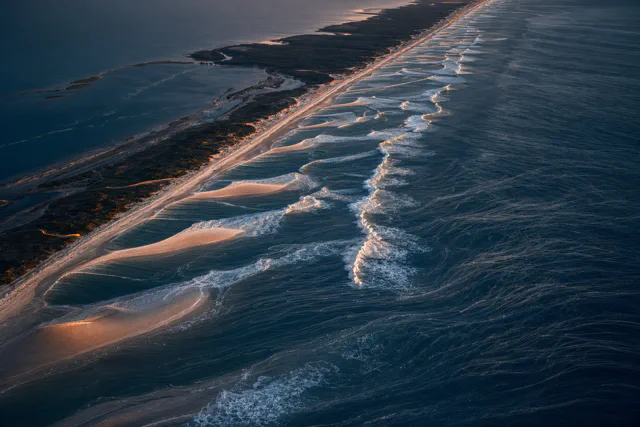
The morning after a storm, a nourished beach can look as if the project has vanished. The dry beach is narrow, the dune face is cut back, and sand visible a day earlier lies underwater. To the owner, it can look like total loss.
A photograph cannot locate the displaced sand.
Some material may have moved into nearshore bars that continue to reduce wave energy and may return landward under calmer conditions. Some may have washed over the dune, moved alongshore into the next reach, or crossed a depth or inlet boundary from which return is unlikely. The maintenance decision depends on distinguishing redistribution from loss.
Coastal morphodynamics tracks the feedback among water, sediment, and changing landform. A project needs enough of that understanding to keep the wrong boundary, time scale, or material assumption from deciding the design.
Start with the account
The first useful relation is plain:
change in stored sediment = inputs - outputs
The arithmetic fits on one line. The difficulty lies in drawing the account.
A sediment budget needs a geographic boundary, a vertical boundary, and a time interval. A one-kilometer beach reach may lose volume while a ten-kilometer littoral cell gains it. A summer survey may show recovery that disappears after the next winter storm. A calculation above the waterline may report a severe loss while a full profile survey finds the same material stored offshore.
The US Army Corps of Engineers Coastal Engineering Manual provides the framework for tracing sediment sources, pathways, sinks, and storage. The USACE Regional Sediment Management program extends that account across project boundaries. Material dredged from a navigation channel may supply a nearby beach or wetland when timing, grain size, contamination status, placement geometry, and permits align.
Volume records how much material moved; grain properties help determine what it will do. Fine material can travel farther offshore or remain suspended longer than native beach sand. Coarser material can build a steeper profile. Carbonate fragments can abrade or break differently from quartz sand. A budget that treats every cubic meter as interchangeable can balance numerically and fail physically.
Uncertainty belongs in the account. Sediment transport is episodic, and a few storms can move more material than months of ordinary conditions. Survey error can be large relative to the annual change being measured. An honest budget may be a range with a named residual rather than a single precise number.
A fixed edge changes the neighbors
Waves that reach the coast at an angle help drive sediment alongshore. Direction and rate vary with wave climate, shoreline orientation, grain size, water depth, and local structures. A reach tends to build where more sediment enters than leaves and retreat where more leaves than enters.
A jetty, groin, reclamation edge, dredged channel, or natural headland can interrupt that movement. Accumulation on the updrift side shows that the structure is trapping part of the supply. Downdrift erosion may follow as the next reach receives less material.
Responses vary with season, structure geometry, and wave condition. Transport can reverse; sediment may bypass the end; a channel may trap sand only under part of the wave climate. The design has to locate convergence and divergence across the full range of conditions instead of selecting the formula that produces the most confident annual number.
The relevant account extends beyond the parcel. A reclamation can remain stable while exporting erosion to a public beach. A port can maintain its channel by dredging material that would otherwise feed an adjacent coast. The project account must include those transfers and name who pays to manage them.
Storm erosion is movement before it is loss
During a storm, higher water levels and larger waves attack parts of the profile that are usually dry. Sand can move offshore into bars, alongshore, or landward through overwash. The US Geological Survey storm-impact scale distinguishes regimes in which waves remain below the dune, collide with it, overtop it, or inundate the barrier. Those regimes produce different damage and sediment pathways.
Offshore transport can be temporary storage. Bars cause waves to break farther from shore and may migrate landward later. It becomes a more durable loss when sediment leaves the active profile, enters a deep channel or canyon, is carried out of the sediment cell, or is removed by dredging without return.
Overwash presents a different judgment. On an undeveloped barrier, landward sand movement can help the island maintain elevation and migrate as sea level rises. A road, seawall, or dense building line may block that movement because the owner needs the shoreline and access fixed. The natural adaptation process then conflicts with the land use. Nourishment, elevation, structural protection, relocation, and eventual retreat become policy choices, not purely geomorphic outcomes.
This is why a post-storm photograph cannot measure project performance. The owner needs repeated topographic and bathymetric surveys tied to the same datum, extending far enough offshore and alongshore to find the displaced material.
The borrow site belongs on the drawing
Reclamation and nourishment move sediment from one system into another. The excavation site is therefore part of the design.
Compatibility covers grain-size distribution, composition, slope behavior, compaction, drainage, habitat, and exposure. Contamination can make placement unacceptable; shell content, fines, color, and carbonate behavior may also matter. Environmental exclusions and production losses reduce gross deposit volume to the amount actually recoverable.
The Bureau of Ocean Energy Management’s Marine Minerals Program surveys and manages sand, gravel, and shell resources on the federal Outer Continental Shelf for coastal projects. Its work reflects the central constraint: characterization has to precede any claim of supply.
Extraction changes depth and seabed shape. A poorly placed or overly deep borrow pit can alter currents, wave transformation, and benthic habitat. Longer transport distances increase vessel time, fuel use, weather exposure, and cost. Deposit selection therefore has to compare compatible recoverable volume, source effects, transport risk, and cost. A clean construction footprint can conceal a damaging source footprint offshore.
Inlets are moving systems
An inlet connects a bay, lagoon, or estuary to the sea. Its tidal prism is the volume of water exchanged through the inlet during a tidal cycle. The flow associated with that exchange helps shape the channel and the shoals around it.
Change the connected basin area, constrict the opening, deepen the channel, or add a new flow path, and the balance can change. Lower velocities can promote shoaling. Higher velocities can scour the channel or alter adjacent deltas. Ebb and flood deltas store sediment that also participates in the neighboring beach system.
This makes inlet design inseparable from shoreline design. A new land platform near an inlet can change both navigation maintenance and beach supply. A bypass system that moves dredged sand around a jetty may be as important to regional stability as the jetty itself. A concept that treats the inlet as a fixed opening in a fixed map has omitted the mechanism that maintains it.
Simple empirical relations can help screen alternatives, but they should not be treated as guarantees of a stable cross-section. Storm sequence, channel alignment, wave climate, basin geometry, sediment size, and dredging practice all matter.
The vertical account has two moving sides
Water level is measured relative to land, and both can move.
The NOAA sea-level technical report provides scenarios for future sea level along the United States coast. Site design must combine those scenarios with local vertical land movement, measured tides, storm water levels, and the life and consequence class of the project.
New fill adds another motion. The fill itself can densify. Soft foundation soils can consolidate under the added load. Differential settlement can distort roads, utilities, buildings, drainage slopes, and seawalls even when average settlement stays within the elevation allowance. Regional subsidence can lower the whole platform at the same time.
Finished grade becomes a time-dependent performance claim. The design has to state when the grade is measured, how much settlement is expected before and after opening, what freeboard remains under future water-level scenarios, which elements can be adjusted, and what observation would trigger intervention.
Procurement depends on when the movement occurs. Where drains, surcharge, and time can accelerate most settlement, the schedule carries the cost. Where significant movement continues in operation, adjustable connections, survey access, and maintenance funding carry it.
Models narrow decisions
Coastal models can compare layouts, test storms, estimate currents and waves, explore sediment pathways, and identify sensitivities. They cannot certify one exact shoreline for a distant future.
A useful model begins with measured bathymetry, water levels, currents, waves, sediment properties, and shoreline change. Calibration shows that selected parameters can reproduce part of the observed record. Validation against another period provides a stronger test. Neither proves accuracy under a storm sequence, sea-level condition, or geometry outside the observations.
Run the model as an argument among alternatives. What changes when the opening moves? Which reach erodes when the perimeter hardens? Does a different borrow material change the profile? Which result depends on an uncertain boundary condition? How does the maintenance policy affect the answer?
Borrow-material assumptions connect the model to sediment as infrastructure: source compatibility, transport limits, and replacement supply can all change the result.
The USGS Coastal Change Hazards work reports forecasts with uncertainty because coastal response depends on uncertain forcing, terrain, and process assumptions. A project model should do the same. Sensitivity testing reveals which field measurement, design change, or operating rule would most improve the decision.
Monitoring turns the model into an operating instrument. Surveys after construction test whether settlement, shoaling, erosion, and habitat response remain within the expected range. The observations update nourishment intervals, dredging plans, thresholds, and future phases.
Post-storm response follows from the accounting boundary. If pre-storm and post-storm surveys show that most sand remains in the active profile, the owner can watch recovery. If material crossed the boundary, the owner faces a real loss and a maintenance decision. Appearance starts the investigation; the sediment account distinguishes redistribution from loss.